
Nuremberg
“What was the war all about? What was it about?” - 4/5 Stars

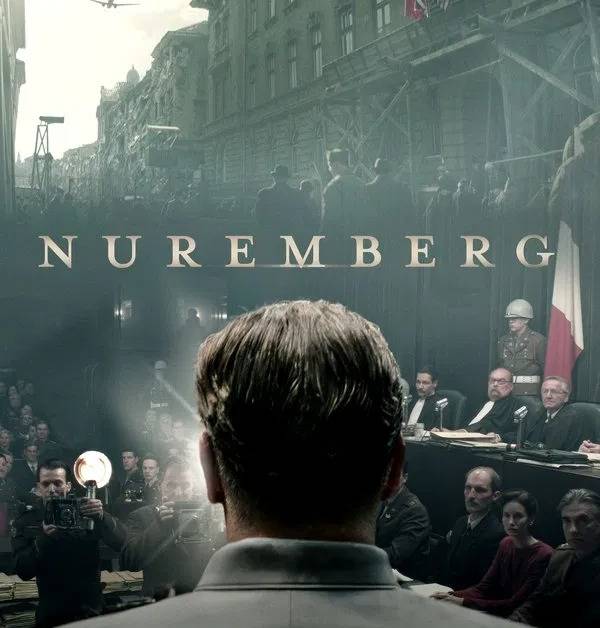
Nuremberg is a historical drama portraying the lead-up to, and the trial that provided justice for, the victims of the key Nazis during World War Two. The accused included Hermann Göring, Joachim von Ribbentrop, Hans Frank and many others from the Nazi Party, as well as key military branches. They were accused of illegally invading European countries and of committing atrocities and war crimes. The trial was established between the USA, USSR, France and Britain. It was also the first of its kind, in the sense that rarely before had countries joined together legally to punish individuals of another country, and it paved the way to the International Criminal Court as well as the legal framework for understanding and applying genocide as a legal charge.
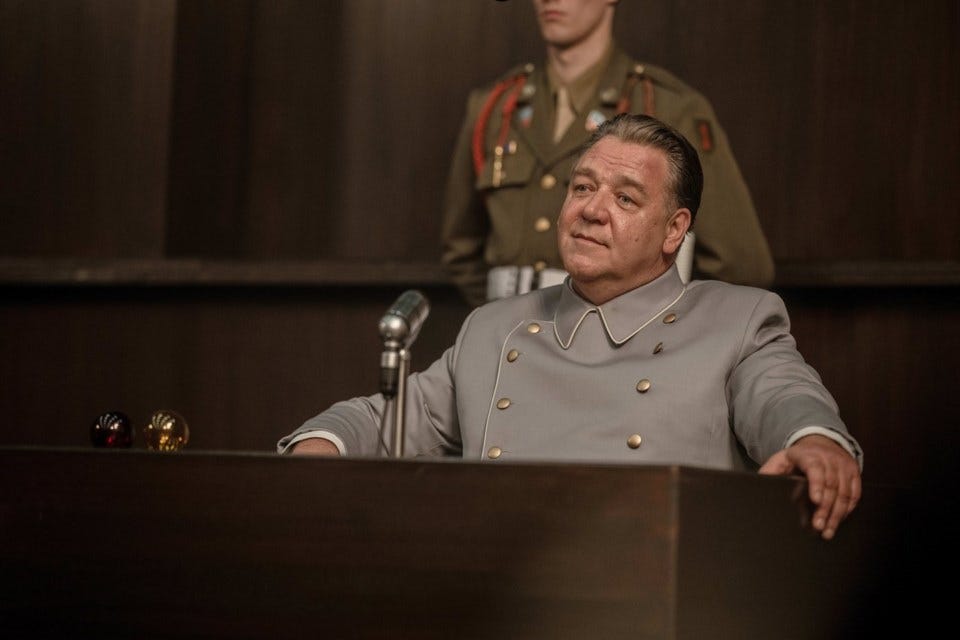
The film bills itself as a psychological thriller, but in reality fixates on relationships. Russell Crowe leads as Göring, the leading player of the Nazi Party who did not commit suicide like Adolf Hitler, Heinrich Himmler and Joseph Goebbels. Being one of the sole remaining individuals of the Nazi high leadership and fiercely intelligent, there is an onus to focus on him above all else, not only in the film but in the trial itself. There are other key individuals, but ultimately they all play a quiet ensemble compared to Göring. In order to better understand Göring and the accused, U.S. Army psychiatrist Douglas Kelley, played by Rami Malek, is tasked with assessing the accused’s personalities and mental well-being in the weeks leading up to the trial.
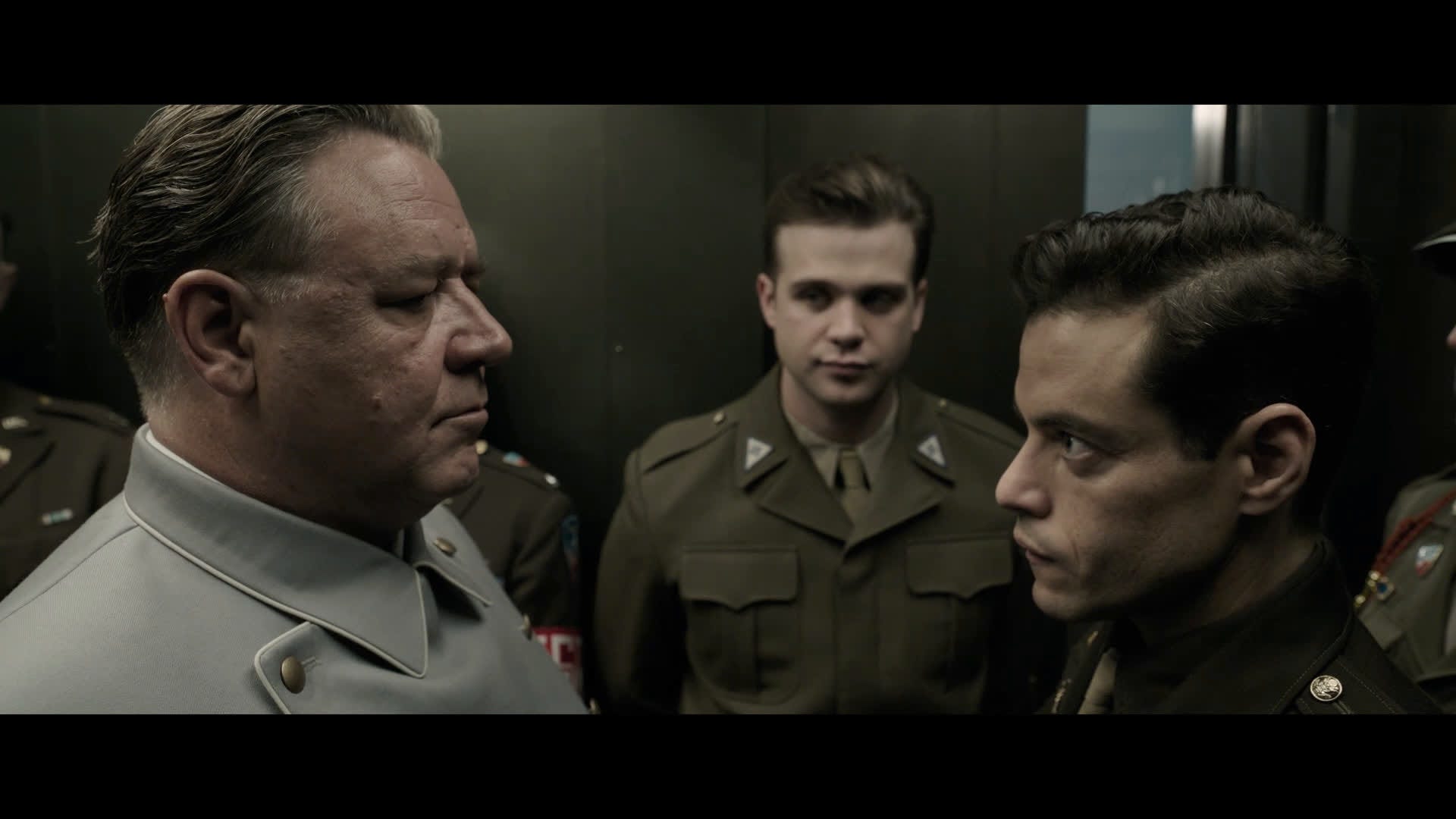
This is the crux of the film. It follows Kelley, who incidentally befriends Göring through a chess match of brinkmanship and calculation. Göring is posited as a master manipulator, and Kelley as the ambitious psychiatrist who is confident he can figure Göring out.
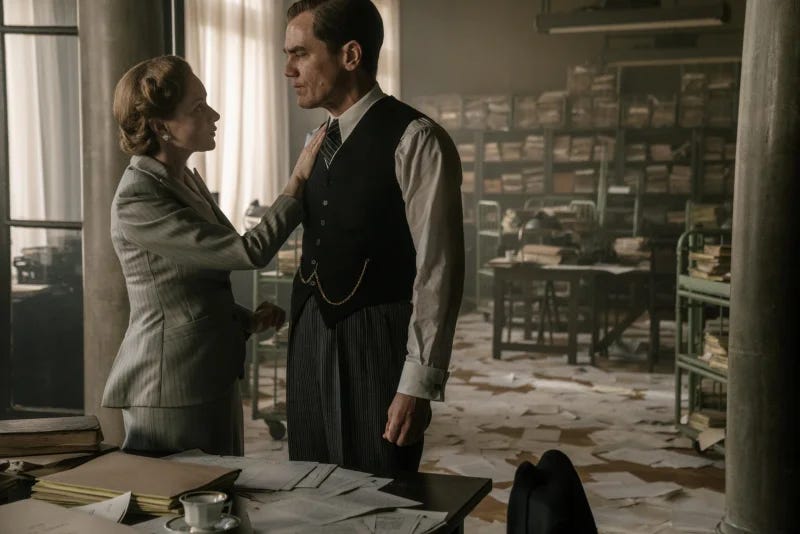
At the same time, we are given snippets of Associate Justice Robert Jackson, played by Michael Shannon, one of the prosecutors of the trial, who struggles with the best way to successfully pin down the leaders within the confines of the law, some of which need to be created and used for the first time. He grapples with issues over intent and how much the accused knew about death camps and the decision-making of the government and military, which was purposely shrouded in faceless bureaucracy. In a pertinent scene early on, Jackson and his wife question where they stop prosecuting. Do they go after the leaders who passed laws that caused war atrocities, as well as the men lower down who carried them out and were simply following orders?
Russell Crowe is absolutely brilliant as Hermann Göring. His accent and screen presence are formidable and give the daunting character of Göring justice. Crowe is able to show Göring’s mind ticking away, assessing every single moment as a chance to mentally pounce on the people around him. Every move is carefully considered, despite the toll of his position, arrested and likely to be executed for his crimes. Yet Crowe does this while also showing Göring’s bascinet secured firmly over his face to ensure he gives nothing away to his captors. Crowe’s performance as Göring will be a defining feature of his already esteemed career. Göring’s arrogance, his cult of personality, and sharp intelligence help make this film something special, and Crowe will most definitely be nominated for Best Supporting Actor in the awards season.
There was also a panoply of incredible acting from many second-tier players, such as Richard E Grant as Sir David Maxwell Fyfe, and the various actors portraying the Nazi leaders, who showed dismissiveness prior to the trial and pitiful emotional outbursts at the end of it.
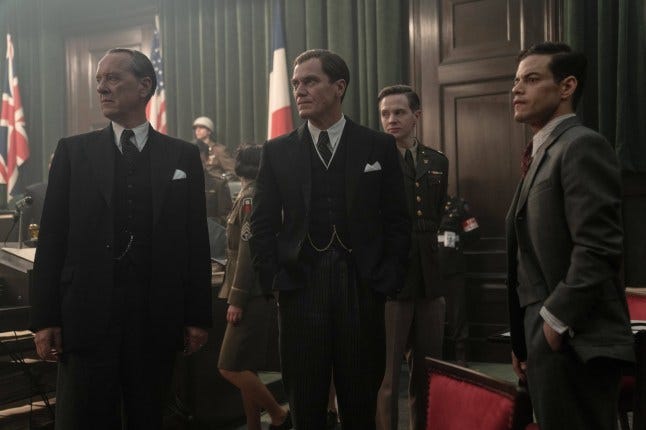
Michael Shannon also displayed sheer brilliance in his role as Justice Jackson. He was able to project the weight of the world on his shoulders. His screen presence was the closest to Crowe’s in terms of being drawn into every word and movement made. At the end of Nuremberg, I was left wanting so much more from Shannon, and it was a shame that his role and that aspect of the trial were muted in favour of the psychiatrist Kelley.
Rami Malek had his moments, but sadly overacted across the film. His presence in so much of the film did feel like too much. His face quivered too much, and his eyes carried the intensity of a drug addict. His emotional scenes were also overdramatic and missed the right tone for many moments. I think Malek was intimidated by the cast around him and, as such, tried to compensate by ratcheting up his facial features and delivery of lines to match the experienced actors around him. And yes, I am being unfair to him because that is the face he has, but a quick Google of Douglas Kelley will show a decidedly different person with an entirely different presence and character than the one Malek brought to the film. Further to this, Malek is simply too suave and soigné to play a nerdy psychiatrist. The constant smoking of cigarettes, which was meant to demonstrate Kelley falling apart from the stress of trying to combat Göring, actually looks like one of those really cool smoking advertisements from the 1950s. As such, I would say this was a miscast.
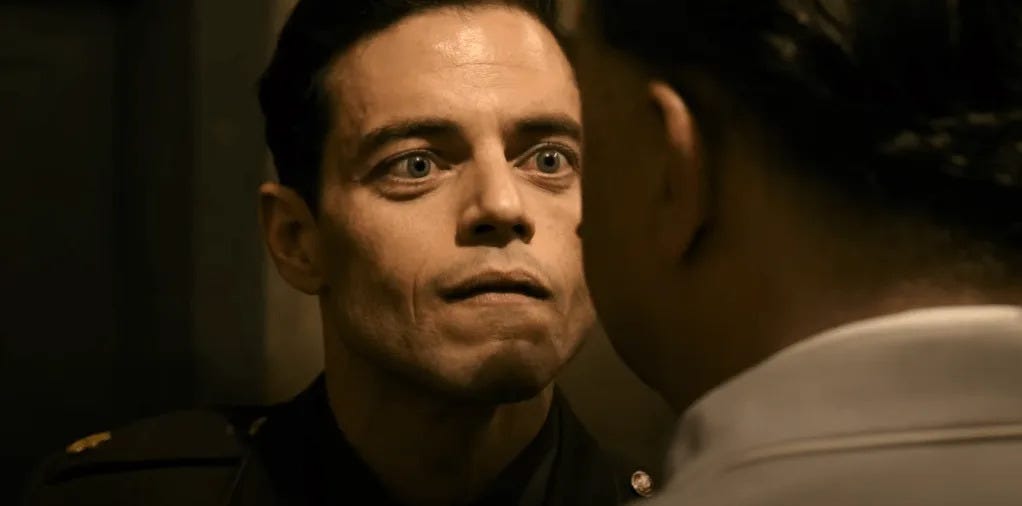
Ultimately, the film falls apart because it has too much going on. The macro of the film is the relationship between Kelley and Göring, with their battle of minds. The micro is the trial itself and Justice Jackson’s objective to nail Göring and his cronies. The filmmakers wanted the two storylines to complement each other, but the area they should have focused on was the complications of putting on an international trial of people from a sovereign country. The Kelley Göring dynamic could have worked, but Malek’s performance lets it down. More importantly, it sends the wrong message. Through this storyline, Göring is humanised, and even in small moments, the film wants you to sympathise with him and feel sorry for him. And that is exactly what we want in movies now. We want to sympathise with the Nazis… Why do this? He was a key player in the Nazi aggression that conquered half of Europe and the near extermination of Jewish people in Europe. Yes, evil can be shown as banal, such as in The Zone of Interest; it just should not have been done in this way. But do not worry, my far right friends, soon we will have Hitler Not Everything He Did Was Bad and The Little Boy Who Wanted to Be a Soldier, A Himmler Story.
In the third act, we do see a lot more court action led by Shannon, which is pleasing, but it is apparent that the filmmakers did not think through how best to legally crush Göring with the dramatic and realistic climax it deserves. The plot device used to “get” Göring is frankly weak, and it felt like the filmmakers dismissed the audience’s intelligence by assuming the conceit used would pass as believable.
A short note on the music. It was excellent. It felt emblematic and poignant to this monumental moment in history. It was the kind of soundtrack that fit into every scene perfectly and enhanced the weight of the story very well.
Ultimately, Nuremberg is a film that squeezes in too much. I do not think this story would have been as powerful as a limited series, though. The early court scenes in which the prosecution shows extended footage of the death camps only work because they have been built up for almost an hour and a half, and because of that sustained building of tension. The brevity of that moment would not have worked in episode three of a four-part series.
Nuremberg would have benefitted from a carefully constructed storyline in which Justice Robert Jackson went toe to toe with Göring in the courtroom, rather than Kelley. The two standout actors in Nuremberg, Crowe and Shannon, would have demonstrated the ruthless and implacable Göring, as well as the more appropriate and engaging story of Jackson trying to outfox him.
While muddled, the film does pose interesting factors that are relevant today:
The limitations of a country’s sovereignty to bring justice. Think Russia and Israel.
The trap of the cult of personality, especially when you meet the person.
The problem of significance. Both Göring and Kelley have the same desire to be greater than themselves.
The need for due legal process, despite the fact that the figures on trial are doomed, irrespective of their defence.
I have a habit of declaring movies muddled or too jam-packed, but in spite of this, I do think Nuremberg is still a really good film. It made me think and gave me an exhilaration, which is what films are meant to do. And for that, I will happily watch this film again and again.
On a separate note, if you like this type of film, go watch Judgment at Nuremberg. It is an oldie but a goodie.
4/5 stars.